CONSUMERISM: DIET COKE AND THE HOLOCAUST
2024
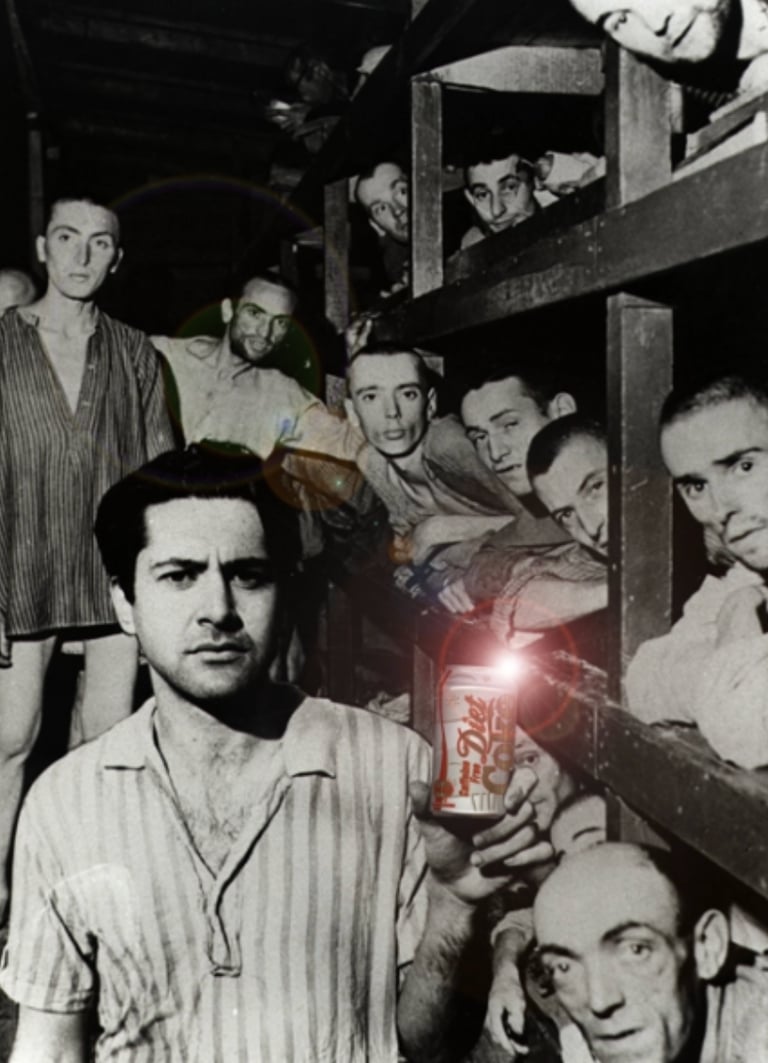
Alan Schechner’s It’s the Real Thing—Self-Portrait at Buchenwald, is a photograph from 1991-93 which features a scene of Holocaust prisoners in the barracks of a concentration camp. Thirteen prisoners distinguishable by their striped clothing make eye contact with the viewer. Over the original image, Schechner inserts a modern photo of himself dressed in the same striped garments. He holds up a can of Diet Coke, which shines a light similar to that of a camera. In this essay I will argue that Schechner’s photograph presents consumption as a means of self-identification. I will discuss the motif of the Coke can, eye contact, facial expression, and Schechner’s insertion of himself as a Jewish man as supportive evidence to my thesis.
Alan Schechner was a Jewish man himself, born into a post-Holocaust generation that reflected on memories and photographs of the Holocaust as a historical event, that of the past. The photograph It’s the Real Thing—Self-Portrait at Buchenwald is in black and white, akin to the photographs produced under the technology during the time of the Holocaust (1941-1945). All details in the background are historically accurate, as the template of the photograph is a historical photograph taken from a concentration camp; the men in the barracks look unhappy, starved, and are crammed together in a confined space. The lines on their faces are sunken in with dark shadows and they make distressed expressions as they make eye contact with the viewer. Schechner’s insertion of himself into the photograph, though taken decades later, looks similar to his surroundings. He himself is also in black and white, he is dressed in similar striped clothing, and he is not smiling . As Mark Reinhardt writes in Beautiful Suffering, It’s the Real Thing—Self-Portrait at Buchenwald acts as “an act of both identification and dis-identification.” As a Jewish man positioning himself among generations of past Jewish men suffering during the Holocaust, Schechner identifies himself as a descendent of this generational trauma. He depicts himself as visually similar to the prisoners, drawing comparisons between his identity as a modern day Jew and those of the Jews that perished before him. Despite the similarities, though, Schechner utilizes visual elements to draw a distinction between himself and the prisoners, creating, as Reinhardt puts it, an act of “dis-identification.” While the expressions on the prisoners’ faces show fear, Schechner’s self-portrait’s expression is one of self-assured disgust. His eyes are not widened in fear like the surrounding men, but his brow is furrowed in passion and interest. He makes direct eye contact with the viewer, sneering in disapproval of them for looking at the photograph in the first place. With all of the eyes in the photograph on the viewer, a sense of vulnerability within the audience is inspired. Schechner’s self portrait’s expression, contrasted against the fear of the prisoners, seems judgemental, silently judging the viewer for their consumption of such an image. In Beautiful Suffering, Reinhardt questions what it means “for Jewish culture…to consume images of the Shoah (Holocaust) as a way of forming or showing one's identity or moral claims.” In his photograph, Schechner proves that the consumption of Holocaust photographs leads viewers to question their own identity among the throws of Jewish history, and their own history. Through the consumption of It’s the Real Thing—Self-Portrait at Buchenwald, we are forced to interact intimately with the human experience of the Holocaust, and draw personal connections between our modern selves and the generational trauma that happened less than a century ago. With the eyes of the prisoners, including Schechner, on us as the viewer, we are led to situate ourselves among the generational trauma and collective history of our ancestors.
One important detail in Schechner’s photograph is the Diet Coke can held up in Schechner’s hand. It clearly stands out as the only colored object in the photograph, and emits a flash of colored light echoing a camera’s effect. The motif of the Diet Coke is interesting as a symbol of consumption, because Diet Coke, compared to the standard Coca Cola drink, contains no calories whatsoever and is purely consumed for pleasure. As Reinhardt writes, Schechner comes from “a world in which millions of people pay to drink a beverage because it provides no nourishment,” starkly contrasting with the starving faces of the prisoners in the background. While the Holocaust prisoners exhibit signs of starvation, Schechner’s self portrait consumes a beverage that will not bring him any sustenance, but rarely serves as a modern world luxury. Through the implied consumption of the can of Diet Coke, Schechner highlights the ways we can identify ourselves through our consumption. We can place ourselves into categories of class, race, religion, and gender through measuring not only what we visually consume, but what we physically consume as well. The motif of the Diet Coke can urges viewers to place themselves amongst themselves, their ancestors, and those who have suffered before us. Schechner creates a dialogue on how we can measure our consumption in terms of self-identification, whether that be consuming a beverage or a photograph of the Holocaust.